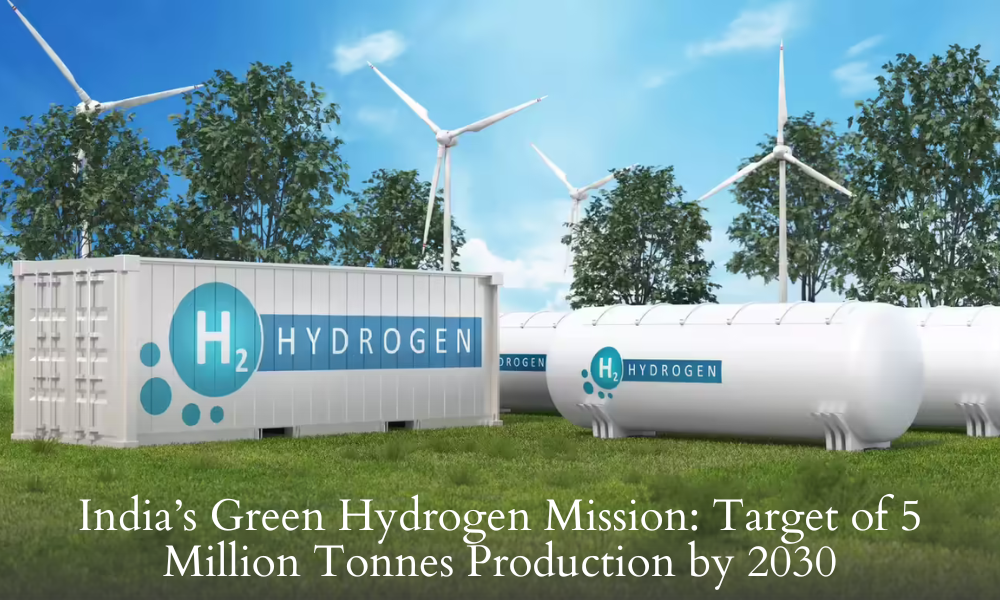
India’s Green Hydrogen Mission: Target of 5 Million Tonnes Production by 2030
India is entering a decisive phase in its clean energy transition, driven by the dual challenges of climate change and energy security. As the country strives to reduce its dependence on fossil fuels and meet long-term decarbonization goals, green hydrogen has emerged as a transformative solution. Recognizing its potential, the Government of India has launched the National Green Hydrogen Mission, setting an ambitious target of producing 5 million tonnes of green hydrogen annually by 2030. This mission positions India to become a global hub for green hydrogen production, export, and innovation.
Understanding Green Hydrogen
Green hydrogen is produced by splitting water into hydrogen and oxygen using electricity generated from renewable sources such as solar and wind. Unlike grey or blue hydrogen, which rely on fossil fuels and emit carbon dioxide, green hydrogen is a truly clean energy carrier. It can be stored, transported, and used across sectors, making it a versatile solution for decarbonizing hard-to-abate industries.
For India, with its vast renewable energy potential, green hydrogen offers a pathway to convert abundant sunlight and wind into a clean fuel that can power industries, transport, and power generation.
Why Green Hydrogen Matters for India
India is the world’s third-largest energy consumer, and its energy demand is expected to grow steadily in the coming decades. Heavy industries such as steel, cement, refineries, and fertilizers rely heavily on fossil fuels, making decarbonization challenging. Green hydrogen can replace carbon-intensive fuels in these sectors, significantly reducing emissions.
Additionally, India imports a large share of its energy requirements, exposing the economy to global price volatility. Producing green hydrogen domestically enhances energy independence and strengthens economic resilience.
The National Green Hydrogen Mission
The National Green Hydrogen Mission aims to create a comprehensive ecosystem for hydrogen production, storage, distribution, and utilization. The target of 5 million tonnes per year by 2030 is supported by parallel goals, including the development of renewable energy capacity, electrolyzer manufacturing, and supporting infrastructure.
The mission focuses on encouraging private sector participation, fostering innovation, and building international partnerships. It also aims to create millions of jobs while positioning India as a leader in the global hydrogen economy.
Renewable Energy as the Backbone
Achieving the 5 million tonnes target will require massive renewable energy capacity. Solar and wind power will form the backbone of green hydrogen production in India. The country’s geographical advantage—high solar irradiation and vast wind corridors—makes it well-suited for large-scale hydrogen projects.
By integrating hydrogen production with renewable energy generation, India can also address the intermittency challenges of solar and wind power. Excess renewable electricity can be used to produce hydrogen, which can be stored and used when needed.
Industrial Applications of Green Hydrogen
One of the key drivers of India’s Green Hydrogen Mission is industrial decarbonization. In the fertilizer sector, green hydrogen can replace fossil-based hydrogen used in ammonia production. In steel manufacturing, it can be used as a reducing agent, significantly lowering carbon emissions.
Refineries can also utilize green hydrogen for cleaner fuel processing. Over time, hydrogen-based technologies can help Indian industries align with global sustainability standards, improving competitiveness in international markets.
Green Hydrogen in Transport and Power
Beyond industries, green hydrogen has significant potential in the transport and power sectors. Hydrogen fuel cells can power buses, trucks, trains, and even ships, offering long-range, zero-emission alternatives to conventional fuels. For heavy and long-distance transport, hydrogen provides advantages over battery-electric solutions.
In the power sector, hydrogen can be used for energy storage and grid balancing. It can be converted back into electricity during peak demand periods, supporting grid stability and renewable energy integration.
Economic Opportunities and Job Creation
The Green Hydrogen Mission is not just an environmental initiative but also an economic opportunity. Developing a domestic hydrogen value chain—from electrolyzer manufacturing to storage, transport, and end-use applications—can create large-scale employment.
India has the potential to become a major exporter of green hydrogen and its derivatives, such as green ammonia and green methanol. This could open new revenue streams and strengthen India’s position in the global clean energy market.
Challenges in Achieving the 2030 Target
Despite its promise, the mission faces several challenges. High production costs remain a major barrier, as electrolyzers and renewable energy infrastructure require significant investment. Reducing costs through technological innovation, economies of scale, and supportive policies will be critical.
Infrastructure development is another challenge. Hydrogen storage, transportation, and safety standards need to be established at scale. Additionally, creating demand across sectors requires coordinated policy support and long-term offtake agreements.
Policy Support and International Collaboration
Strong policy frameworks and incentives are essential for the success of the Green Hydrogen Mission. Financial support, research and development funding, and clear regulatory guidelines can accelerate adoption. International collaboration will also play a key role, enabling technology transfer, investment, and access to global markets.
India’s participation in global hydrogen alliances can help align standards and enhance export potential.
The Road Ahead
Reaching the target of 5 million tonnes by 2030 will require coordinated efforts across government, industry, and academia. Strategic planning, continuous innovation, and stakeholder collaboration will determine the mission’s success. As technologies mature and costs decline, green hydrogen can become a cornerstone of India’s clean energy future.
Conclusion
India’s Green Hydrogen Mission marks a bold step toward a sustainable and self-reliant energy future. By targeting 5 million tonnes of green hydrogen production by 2030, India aims to decarbonize key sectors, strengthen energy security, and position itself as a global leader in clean energy. While challenges remain, the mission’s long-term benefits—environmental, economic, and strategic—make green hydrogen a vital pillar of India’s transition to a low-carbon economy.