
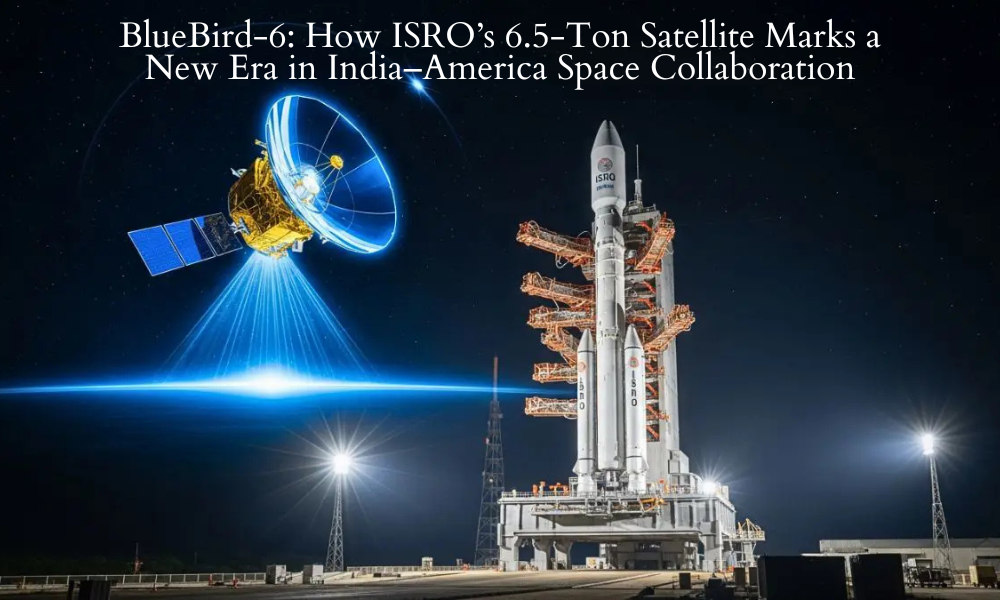
India’s space journey has always been a story of persistence, innovation, and vision. Every milestone achieved by the Indian Space Research Organisation (ISRO) not only strengthens India’s position in global space science, but also showcases the nation’s growing technological independence. The upcoming launch of BlueBird-6, a 6.5-ton communication satellite, is one such chapter—significant not just for India, but also for its growing partnership with the United States in space technology.
BlueBird-6 is reported as one of the heaviest American satellites that will be launched with India’s help. The mission is expected to begin its journey this coming Monday, marking another high-value commercial launch for ISRO and reinforcing India’s presence in the global satellite-launch marketplace.
A Giant Step in Heavy Satellite Handling
Handling a satellite that weighs 6.5 tons is no small engineering feat. It demands advanced infrastructure, precise calculations, and rock-solid launch capability. Until a decade ago, such heavy payloads were considered beyond the reach of developing space agencies. But India has crossed that barrier.
ISRO has been gradually expanding its ability to launch heavier satellites using powerful launch vehicles. With the advent of the GSLV Mk-III (recently renamed LVM-3), India proved it can send multi-ton payloads into Low Earth Orbit (LEO). The BlueBird-6 launch further solidifies this capability, as it showcases that ISRO’s commercial launch services are trusted even for high-value, heavy-duty foreign missions.
This trust is not accidental. Over the past several years, ISRO’s launch reliability has reached world-class levels. International clients now view the Indian launch ecosystem as affordable, dependable, and technically advanced.
Why the BlueBird-6 Mission Matters
- Strengthening India–US Technological Partnership
Space cooperation is becoming a crucial pillar of India–US relations. BlueBird-6 being an American satellite shows how deeply intertwined the technical collaboration has become. Such missions create:
- Stronger commercial ties
- Higher scientific exchange
- Joint exploration opportunities
- Boosts in geopolitical friendship
The United States selecting India for launching strategically important satellites signals immense trust.
- Expanding India’s Commercial Space Market
India’s commercial launch arm, NSIL (NewSpace India Limited), has been attracting foreign clients thanks to competitive pricing. Launching BlueBird-6 adds yet another big achievement to this commercial portfolio.
The global satellite-launch market is worth billions of dollars. India, due to its cost-efficient engineering model, is steadily capturing a larger share. BlueBird-6 enhances India’s reputation in:
- Heavy satellite launch services
- Communication satellite management
- International satellite deployment
- A Benchmark for Future Mega Missions
BlueBird-6’s size and technical complexity make this launch an important rehearsal for future mega-missions, including:
- Next-generation navigation satellites
- Deep-space exploration projects
- Heavier Earth-observation satellites
- Commercial cluster launches
Every such mission trains ISRO scientists for even bigger challenges ahead.
Inside the BlueBird-6 Satellite
Although the exact proprietary details of BlueBird-6 remain confidential (as is common for commercial and strategic satellites), it is known that:
- It is designed for high-bandwidth communication services.
- It will operate in Low Earth Orbit (LEO).
- Its applications may include broadband connectivity, aviation communication, maritime communication, and emergency services.
- It has large, powerful solar arrays and advanced communication transponders.
The satellite’s 6.5-ton mass makes it one of the largest satellites that ISRO has launched for an international client—an achievement of great pride.
LEO: The New Frontier of Global Internet and Communication
BlueBird-6 will orbit the Earth in Low Earth Orbit, a zone between 200 km to 2,000 km above Earth’s surface. This region is becoming extremely important for global communication because:
- LEO satellites have low latency, meaning faster internet.
- They can provide connectivity in remote areas where fiber cannot reach.
- Networks of LEO satellites can create global broadband coverage.
- They support next-generation communication systems like 5G and satellite-IoT.
With more companies entering the LEO race, India’s growing participation through ISRO is strategically valuable.
ISRO: The Engine Behind India’s Space Rise
From launching India’s first small satellite in the 1970s to launching complex lunar and Mars missions, ISRO has always embraced challenges with creativity and teamwork. Its biggest strengths include:
- Cost-efficient engineering
- High reliability
- Indigenous development
- Strong scientific leadership
- Growth mindset
BlueBird-6’s launch continues this tradition by proving that Indian capabilities match global standards.
Boosting India’s Private Space Ecosystem
The BlueBird-6 mission also strengthens India’s private space sector. As more foreign companies collaborate with Indian launch services, opportunities expand for:
- Satellite manufacturing startups
- Component suppliers
- Communication-technology developers
- Aerospace education programs
- Space-tech innovation hubs
India’s space economy, currently around $8–10 billion, is projected to reach $40 billion by 2040. Launches like BlueBird-6 accelerate this growth.
The Road Ahead: India’s Space Future Looks Bright
BlueBird-6 is a testament to a bright future filled with ambitious plans:
- Gaganyaan, India’s first human-spaceflight mission
- Chandrayaan-4 sample-return mission
- Aditya-L2, future solar observatories
- India’s space station
- Deep-space scientific exploration
With every major launch, India steps closer to becoming a global space leader.
Conclusion: BlueBird-6 Is More Than a Satellite—It’s a Milestone
The launch of the 6.5-ton BlueBird-6 satellite is a symbol of:
- India’s rising technological power
- Growing India-US collaboration
- ISRO’s confidence in heavy-lift missions
- India’s expanding role in global satellite services
As the rocket lifts off, it carries not only a satellite but also the aspirations of a nation that has become a key player in modern space exploration.
BlueBird-6 reflects a simple truth:
India is no longer just participating in the global space race—it is helping lead it.