
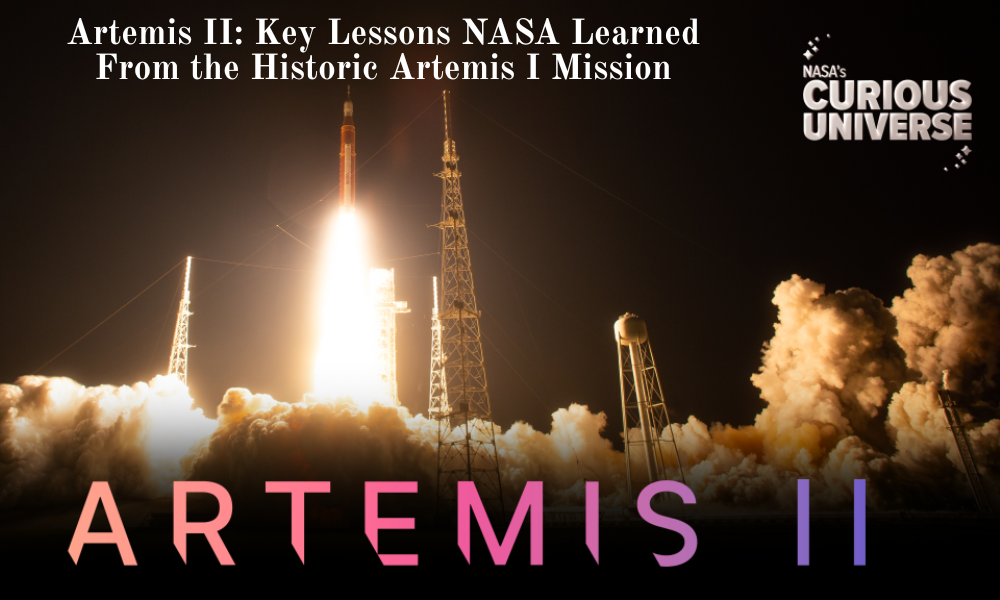
NASA’s Artemis program marks humanity’s bold return to the Moon, laying the foundation for sustained lunar exploration and, eventually, missions to Mars. At the heart of this ambitious program was Artemis I, an unscrewed test flight launched to validate the Space Launch System (SLS), the Orion spacecraft, and the supporting ground infrastructure. While Artemis I did not carry astronauts, it carried immense expectations. The mission’s success and the challenges it revealed provided critical lessons that are now shaping Artemis II, the first crewed mission of the Artemis era.
The Purpose of Artemis I
Artemis I was designed as a comprehensive, end-to-end test of NASA’s deep-space exploration system. The mission aimed to evaluate the performance of the SLS rocket, test Orion’s systems in the harsh environment of deep space, and verify the spacecraft’s heat shield during high-speed re-entry into Earth’s atmosphere. By sending Orion beyond the Moon and safely returning it, NASA sought to reduce risks before committing astronauts to the journey.
The mission exceeded expectations in many areas, completing a distant retrograde orbit around the Moon and traveling farther than any human-rated spacecraft had ever gone without a crew. However, it also uncovered technical and operational insights that are directly influencing Artemis II.
Lessons From the Space Launch System (SLS)
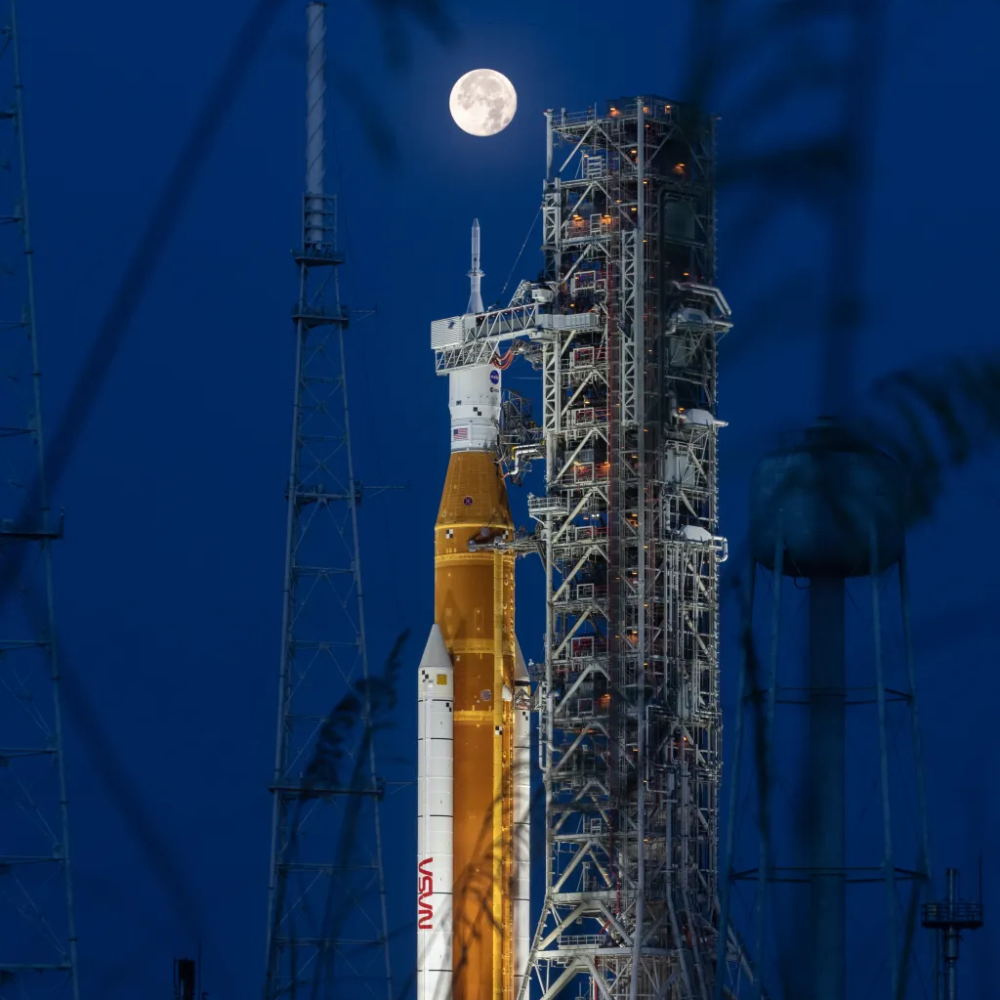
One of the most significant takeaways from Artemis I was the overall performance of the Space Launch System. The rocket delivered Orion precisely into its planned trajectory, confirming the core stage, solid rocket boosters, and RS-25 engines functioned as designed. This success gave NASA confidence in SLS as a reliable heavy-lift vehicle for crewed lunar missions.
At the same time, Artemis I highlighted the complexity of launch preparations. Several launch attempts were delayed due to issues such as hydrogen leaks, sensor anomalies, and weather constraints. These challenges underscored the need for refined fueling procedures, improved ground systems, and better decision-making frameworks. For Artemis II, NASA has updated protocols, improved leak detection methods, and enhanced coordination between engineering and launch teams to minimize delays and increase readiness.
 Orion Spacecraft Performance Insights
Orion’s performance was a central focus of Artemis I, and the spacecraft delivered a wealth of data. Power generation from its solar arrays exceeded requirements, and its navigation, communication, and propulsion systems performed reliably throughout the mission. This success confirmed Orion’s capability to support long-duration missions beyond low Earth orbit.
However, Artemis I also revealed areas for improvement. Some power and thermal management components behaved differently than predicted, and engineers identified wear patterns in certain systems that will be addressed before Artemis II. These findings have led to targeted upgrades, software refinements, and additional testing to ensure Orion can safely support astronauts for extended periods in deep space.
Heat Shield and Re-entry Discoveries
Perhaps the most critical phase of Artemis I was Orion’s return to Earth. The spacecraft re-entered the atmosphere at speeds approaching 40,000 kilometers per hour, testing its heat shield under extreme conditions. Overall, the heat shield performed successfully, protecting Orion during one of the most challenging re-entries ever attempted.
Post-flight analysis, however, revealed unexpected char patterns and erosion behavior on the heat shield. While these did not compromise mission safety, they provided invaluable insights into how the material responds to real-world conditions. NASA has since refined its models and made adjustments to the heat shield design and manufacturing processes for Artemis II, increasing confidence in crew safety during re-entry.
Radiation and Deep Space Environment Data
Artemis I carried a suite of sensors and mannequins equipped with radiation detectors to measure exposure levels in deep space. This data is crucial for understanding how cosmic radiation and solar particles affect human bodies during lunar missions.
The findings confirmed that radiation levels beyond Earth’s protective magnetosphere are significant but manageable with proper shielding and mission planning. For Artemis II, NASA is using this data to optimize crew exposure limits, refine spacecraft shielding strategies, and improve emergency response plans for solar radiation events.
Ground Systems and Mission Operations
Beyond the rocket and spacecraft, Artemis I tested NASA’s ground systems and mission operations at an unprecedented scale. The mission validated communication networks, tracking systems, and coordination between multiple NASA centers and international partners.
At the same time, Artemis I highlighted the need for faster data analysis and more streamlined decision-making processes. Engineers are now implementing improved software tools, clearer communication protocols, and enhanced training simulations for Artemis II flight controllers. These changes aim to ensure smoother operations once astronauts are involved.
Human Factors and Crew Readiness
Although Artemis I was unscrewed, it provided essential insights into human factors. The mission tested life-support interfaces, cabin layout, and crew procedures using simulated scenarios. Data from on board sensors helped engineers assess vibration levels, noise, and overall spacecraft environment.
These findings are shaping modifications to crew displays, seating configurations, and emergency procedures for Artemis II. NASA is also incorporating lessons learned into astronaut training programs, ensuring the Artemis II crew is fully prepared for the physical and psychological demands of lunar flight.
How Artemis I Shapes Artemis II
Artemis II represents the transition from testing hardware to testing human capability. The lessons learned from Artemis I have resulted in tangible improvements across the program—from refined launch operations and upgraded spacecraft systems to enhanced safety margins and crew training.
Artemis II will carry astronauts on a lunar flyby, validating life-support systems, navigation, and crew operations in deep space. Every adjustment made based on Artemis I data reduces uncertainty and risk, bringing NASA one step closer to sustainable lunar exploration.
A Stepping Stone to the Future
Artemis I was more than a test flight it was a learning mission that set the stage for humanity’s return to the Moon. The knowledge gained has strengthened NASA’s confidence in its systems while highlighting the importance of iterative improvement.
As Artemis II approaches, the legacy of Artemis I is clear. By embracing lessons learned and applying them rigorously, NASA is ensuring that the next mission not only flies farther but does so with astronauts safely aboard. Together, Artemis I and Artemis II mark the beginning of a new era in space exploration one defined by preparation, precision, and the promise of reaching beyond the Moon toward Mars and beyond.