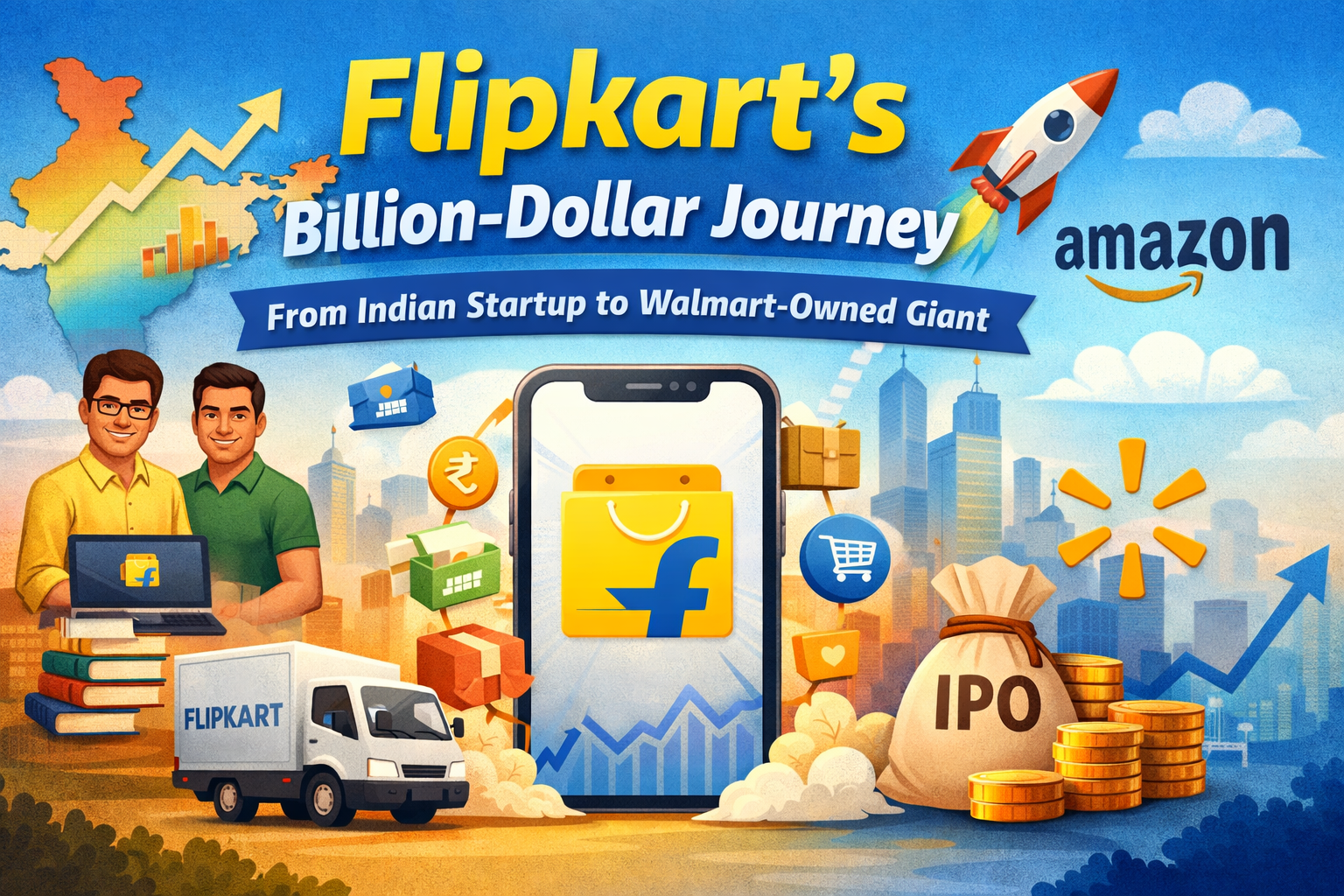
The Flipkart story is one of the most motivational startup success tales in India, where a small online bookstore has been built into a world e-commerce leader. Started in 2007, the company not only grew very quickly in a complex market like India but also held its own against the world giant Amazon. The acquisition of Flipkart by Walmart was a defining moment for Indian startups in the global arena. Today, with the IPO buzz rising, the Flipkart story is one of ambition, perseverance, and the growth of the Indian digital economy.
Starting Small: Flipkart Goes from a Bookstore to a Retailer of Many Things
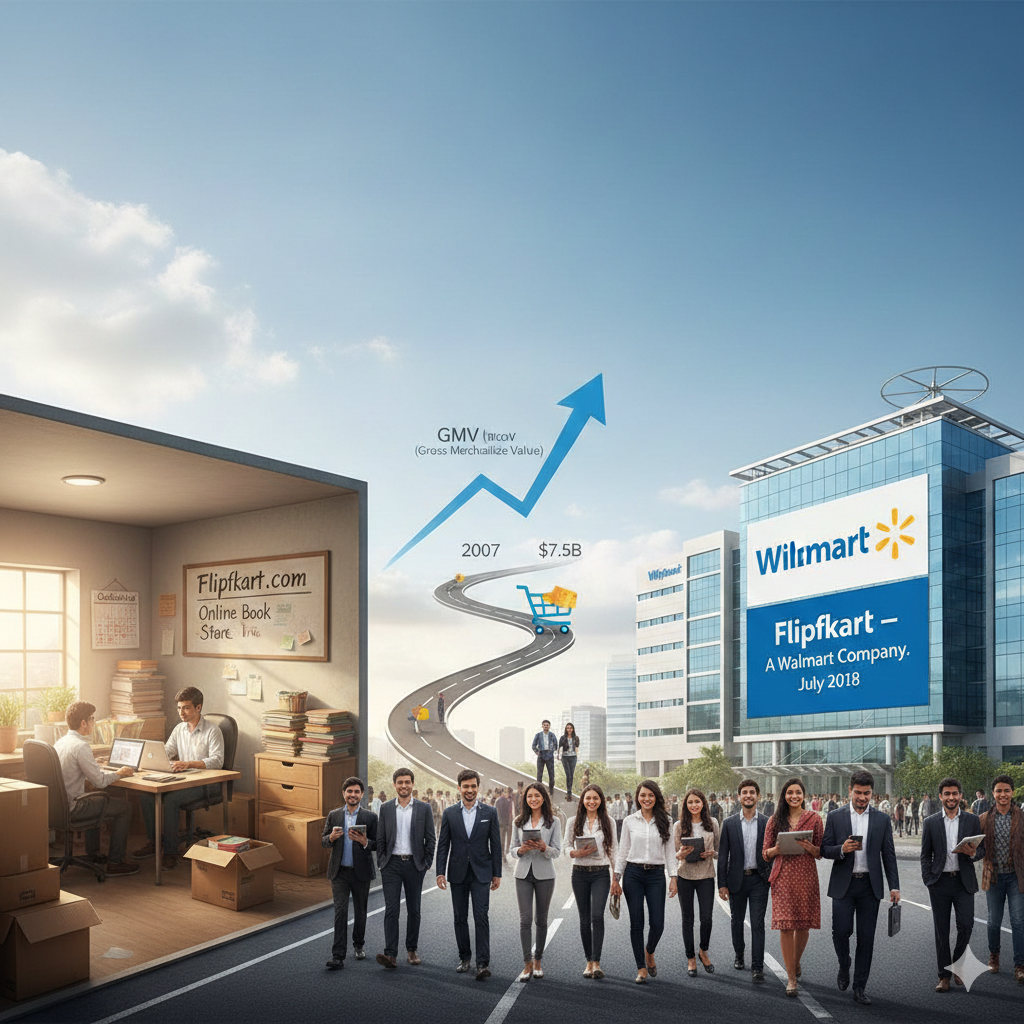
Flipkart began as an online bookstore from Sachin Bansal and Binny Bansal (who had both worked for Amazon) in 2007., operating out of a spare bedroom in Bangalore, India. Flipkart now ranks among the top online retailers in the world. Initially Flipkart had to hurdle many obstacles to succeed, including low internet usage and a general distrust of the internet as well as a lack of logistical infrastructure in India. Rather than give up due to these barriers Flipkart’s founders implemented innovative solutions like Cash on Delivery, and Free Returns to overcome these barriers to create trust in Flipkart by customers and the internet shopping experience. After successfully raising initial funding from Indian and international investors, Flipkart was able to grow from just an online bookstore to a mixed category retailer including electronics, apparel, and home goods very rapidly. In the earliest stages of Flipkart’s existence, the structure of Flipkart established the foundations of its customer centric strategy and operational sustainability. A modest startup, Flipkart eventually became one of the largest eCommerce companies in the entire world and helped launch India’s modern-day eCommerce ecosystem.
Scaling at the Pace of India: Building Infrastructure, Sellers, and Trust
The first and most important thing that Flipkart achieved is scaling up at a pace that is commensurate with the diversity and complexity of a market like India. The company has invested significantly in building logistics through Ekart, creating one of the largest supply chain networks in the country to enable faster and more reliable delivery. It also worked towards enabling small and medium sellers through technology, warehousing, and payments. Its flagship sales events such as the Big Billion Days became a phenomenon in themselves, driving huge sales volumes and engagement. The company’s foray into private labels in the fashion and electronics categories has helped it enhance margins and customer loyalty. On the other hand, data-driven personalization and support for regional languages has helped it reach Tier 2 and Tier 3 cities.
How Amazon Can Influence E-Commerce In India
Initially, Flipkart and Amazon were engaged in a competitive battle, but it eventually changed how people shop online today. Price competition, delivery times, seller onboarding, and the overall experience were all done very aggressively to attract Indian consumers (e.g., discount wars, festive sales, exclusive products). The fact that Amazon had the capital and experience from around the world allowed them to enter the market aggressively. Flipkart, on the other hand, did have a better understanding of the Indian way of life (regulatory environment, consumer preferences), which allowed them to adapt their strategy as well. Government restrictions on foreign companies, such as FDI policies and capital, affected both companies’ decisions to innovate and develop. Overall, the intense competition between the two companies helped develop India’s digital economy, increased the standard of service that Indian consumers expect, gave consumers many more choices than they had before, and improved both companies’ ability to continue competing for many years to come.
Walmart Acquisition and IPO Scenarios: What’s Coming for Flipkart
Flipkart’s acquisition of Walmart was an important milestone in 2018, as it represented a new approach not only for one of India’s leading eCommerce companies but also for the entire Indian startup ecosystem. It confirmed that India was becoming a key global market for growth and that Flipkart’s business model could function. Walmart provided Flipkart with access to global supply chain expertise, financial support, and long-term strategic planning. Moreover, Walmart and Flipkart have focused more recently on transitioning from a fast-growth company to a fully profitable company through improved corporate governance and operating discipline. Speculation continues to grow that Flipkart is preparing for an initial public offering (IPO), which would be one of India’s largest technology IPOs to date. As Flipkart continues strengthening its core businesses and looking into new business initiatives such as quick commerce and financial technology, it is poised to play a pivotal role in transforming the way other Indian startups establish a sustainable scale in the international marketplace.
Conclusion
The story behind how Flipkart evolved from being just an early-stage Indian start-up to a legitimate global powerhouse with backing from Walmart is a testament to the entrepreneurial spirit of India. Not only has Flipkart adapted well to local consumer preferences but it has been able to scale rapidly while taking on some of the largest players on the planet, such as Amazon, which led to Flipkarts defining impact on the eCommerce sector in India . Beyond just valuations and acquisitions, Flipkart has shown that it’s entirely possible to build a truly world-class company from the ground up by using resources and a common purpose that are available locally. As we anticipate an IPO, Flipkart will likely become a model of how innovation, tenacity, and local knowledge can combine to produce a globally significant organisation.