
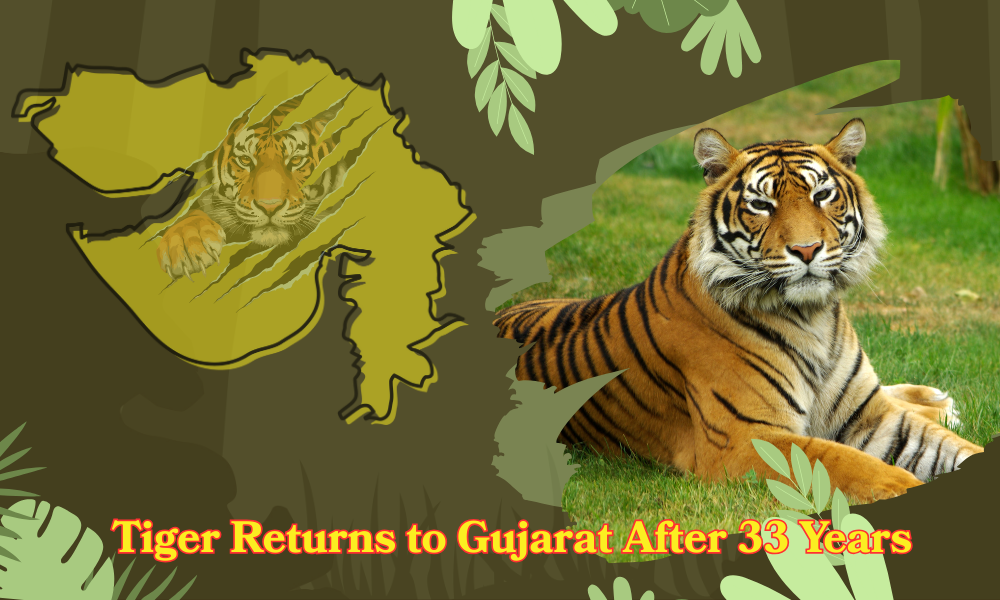
After more than three decades, Gujarat has once again entered India’s elite list of tiger states, marking a historic moment for wildlife conservation. In a development that has thrilled conservationists and nature lovers alike, the presence of a tiger has been officially confirmed in Gujarat, ending a 33-year gap since the last recorded tiger in the state. What makes this achievement even more remarkable is that Gujarat is now the only Indian state to host all three major big cats Lion, Leopard, and Tiger within its boundaries.
This milestone is not just symbolic; it reflects years of focused conservation efforts, habitat protection, and improved forest management. Here’s a detailed, fact-based explanation of how Gujarat became a tiger state again, where the tiger was spotted, and why this moment matters for India’s wildlife future.
Gujarat’s Return as a Tiger State: What Happened?
In 2024–25, forest officials confirmed the presence of a tiger in the state’s forest landscape, marking the first confirmed tiger sighting in Gujarat in over 33 years. The last officially recorded tiger in Gujarat dates back to the early 1990s. Since then, Gujarat had been globally known for Asiatic lions, but not tigers.
The recent confirmation came through:
Camera trap images
Field evidence such as pugmarks
Official verification by forest authorities
Importantly, this is not a speculative or unverified sighting it is formally acknowledged by the Gujarat Forest Department.
Where Was the Tiger Found?
The tiger was detected in the eastern forest belt of Gujarat, close to the Madhya Pradesh–Rajasthan Gujarat Forest corridor. This region forms part of a larger natural landscape that allows wildlife movement across state boundaries.
Key points about the location:
The tiger is believed to be a dispersing individual, likely from Madhya Pradesh
The forest corridor supports natural migration of big cats
Gujarat’s improving forest connectivity played a key role
At present, Gujarat does not have a resident breeding population of tigers, but the confirmed presence qualifies it once again as a tiger-bearing state.
Understanding the “33 Years” Gap
The statement “Gujarat becomes a tiger state again after 33 years” is accurate because:
Gujarat historically had tigers in parts of eastern and southern forests Due to habitat loss and hunting pressures, tigers disappeared by the early 1990s From then until now, no officially confirmed tiger presence existed.
The return of a tiger after such a long gap highlight how ecological recovery and corridor conservation can reverse past losses.
Gujarat: The Only State with Three Big Cats
With this development, Gujarat becomes India’s only state that is home to:
Asiatic Lion
Found exclusively in Gir and surrounding landscapes
Gujarat is the only place in the world where Asiatic lions exist in the wild
Leopard
Widespread across Gujarat
Found in forests, hills, agricultural areas, and even near urban zones
Tiger
Recently confirmed presence
Currently a solitary or transient individual, not a breeding population
This unique combination makes Gujarat a globally important big-cat landscape.
Why Is This a Big Deal for Conservation?
- Proof of Habitat Improvement
The tiger’s arrival indicates:
Adequate prey base
Reduced human disturbance
Improved forest protection
Tigers are extremely sensitive to habitat quality. Their presence automatically signals ecosystem health.
- Success of Wildlife Corridors
The sighting proves that inter-state wildlife corridors are working, allowing animals to move naturally without translocation.
- Strengthens India’s Tiger Conservation Model
India is already home to over 70% of the world’s wild tigers. Gujarat’s re-entry as a tiger state further strengthens this leadership.
Is Gujarat a Full-Fledged Tiger Reserve State Now?
This is an important clarification.
Yes, Gujarat is officially a tiger-bearing state again
No, Gujarat does not yet have a dedicated tiger reserve or breeding population
At present:
The tiger is likely a migratory or dispersing individual
Continuous monitoring is underway
Any future decision on declaring a tiger reserve will depend on:
Long-term presence
Availability of prey
Human–wildlife conflict assessment
Authorities have clearly stated that conservation will be science-driven, not symbolic.
How Gujarat Prepared the Ground for This Return
Gujarat’s conservation model developed primarily for lions indirectly benefited tigers too.
Key contributing factors:
Strong anti-poaching measures
Community involvement in forest protection
Improved prey populations
Scientific monitoring using camera traps
Landscape-level planning beyond protected areas
This approach created a safe and viable environment for large carnivores.
What Happens Next?
Forest officials are now focused on:
Continuous tracking of the tiger
Preventing human–wildlife conflict
Ensuring the animal’s safety
Studying long-term habitat suitability
No immediate plans for relocation or artificial introduction have been announced. The emphasis remains on natural ecological processes.
Why This Moment Matters Nationally
Gujarat’s tiger confirmation sends a strong message:
Wildlife can return if habitats are protected
Conservation success is possible outside traditional tiger states Big-cat conservation must be landscape-based, not state-limited
It also strengthens the case for coexistence-based conservation, something Gujarat has practiced for decades with lions and leopards.
Conclusion
The return of a tiger to Gujarat after 33 years is not just a headline—it is a conservation milestone rooted in verified facts and ecological progress. While the state does not yet host a tiger population, the confirmed presence of a tiger officially restores Gujarat’s status as a tiger state.
Even more significantly, Gujarat now stands alone in India as the only state home to lions, leopards, and tigers, highlighting its unique role in global wildlife conservation. If protected wisely, this moment could mark the beginning of a new chapter in Gujarat’s natural history—one where all three big cats thrive side by side.