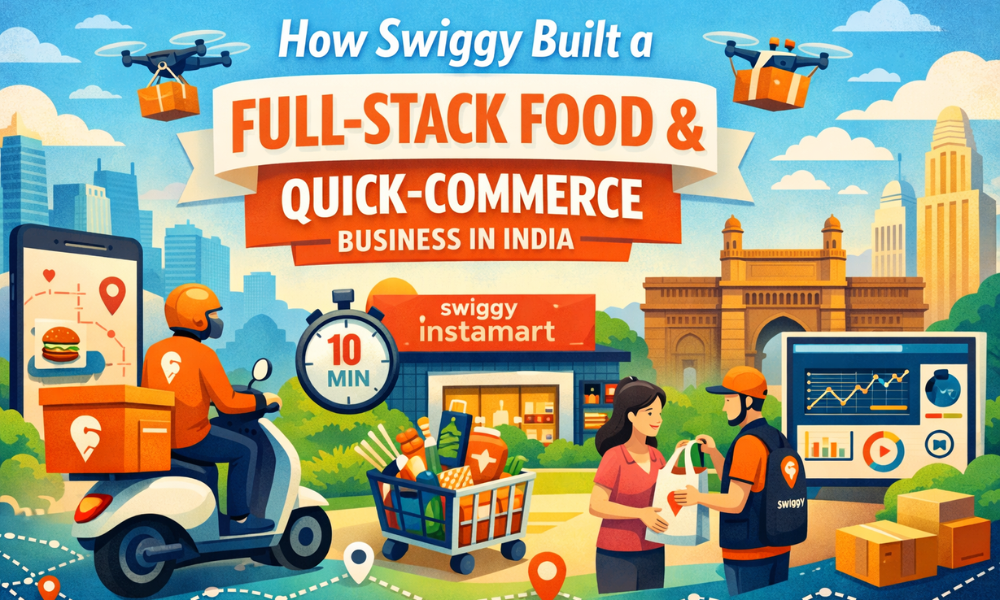
Swiggy was just an ordinary food delivery aggregator, but soon it became India’s most powerful full-stack commerce platform. Swiggy has changed the way Indians shop by owning the technology, logistics, and customer experience. From building a large delivery partner network to launching quick commerce through Instamart, the company has taken the experience of the users to a whole new level. This blog aims to bring to light the way Swiggy created a scalable and tech-enabled ecosystem by offering both food delivery and quick commerce to India’s internet users.
From Food Delivery to Full-Stack Platform: Evolution of Swiggy
Initially, Swiggy started as a food delivery aggregator in 2014. However, the founders were quick to realize that for the business to operate, they would need to partner with restaurants. This, in turn, led to concerns about the scalability and quality of the services. To overcome all these, Swiggy adopted the full-stack model of owning the critical areas such as logistics, technology, support, and forecasting. Thus, the organization was no longer viewed as merely a marketplace for either the customers or the restaurants but as a complete solution. This helped Swiggy to effectively expand and move beyond the traditional food delivery business. Today, the organization offers services such as Swiggy Genie and Instamart, which positions the organization as a convenience store and not merely a food aggregator. This change transformation, therefore, helped the organization to diversify and mitigate the challenges that would otherwise have been caused by the core concept of partnering with restaurants.
Building a Scalable Delivery & Logistics Network Across India
Swiggy built an extensive and scalable logistics network throughout India as one of its greatest advantages. Swiggy developed its own delivery fleets instead of relying on third-party contractors to have more control over the speed, reliability, and quality of service. The company has onboarded hundreds of thousands of delivery partners within cities, using smart routing algorithms to guide delivery partners’ navigation via GPS and real-time order tracking capabilities on the app.
The company uses technology-driven dispatching to create the most efficient delivery routes while optimizing for traffic patterns, weather conditions, etc., to reduce delays and operational costs associated with the delivery. Moreover, Swiggy tailored operations to suit specific requirements in each city based on the local demand/usage patterns and specific infrastructure limitations.
The flexible logistics model, developed by Swiggy, enabled the company to operate at peak times, during festivals, and through the challenges presented by COVID-19.
Because Swiggy treats logistics as a fundamental part of its business and not just an operational function, it has been able to develop a sustainable competitive advantage in logistics, which has enabled Swiggy to expand rapidly throughout urban and semiurban areas in India at a pace that few new companies will be able to match.
Swiggy Instamart & Quick Commerce: Cracking the 10–15 Minute Delivery Model
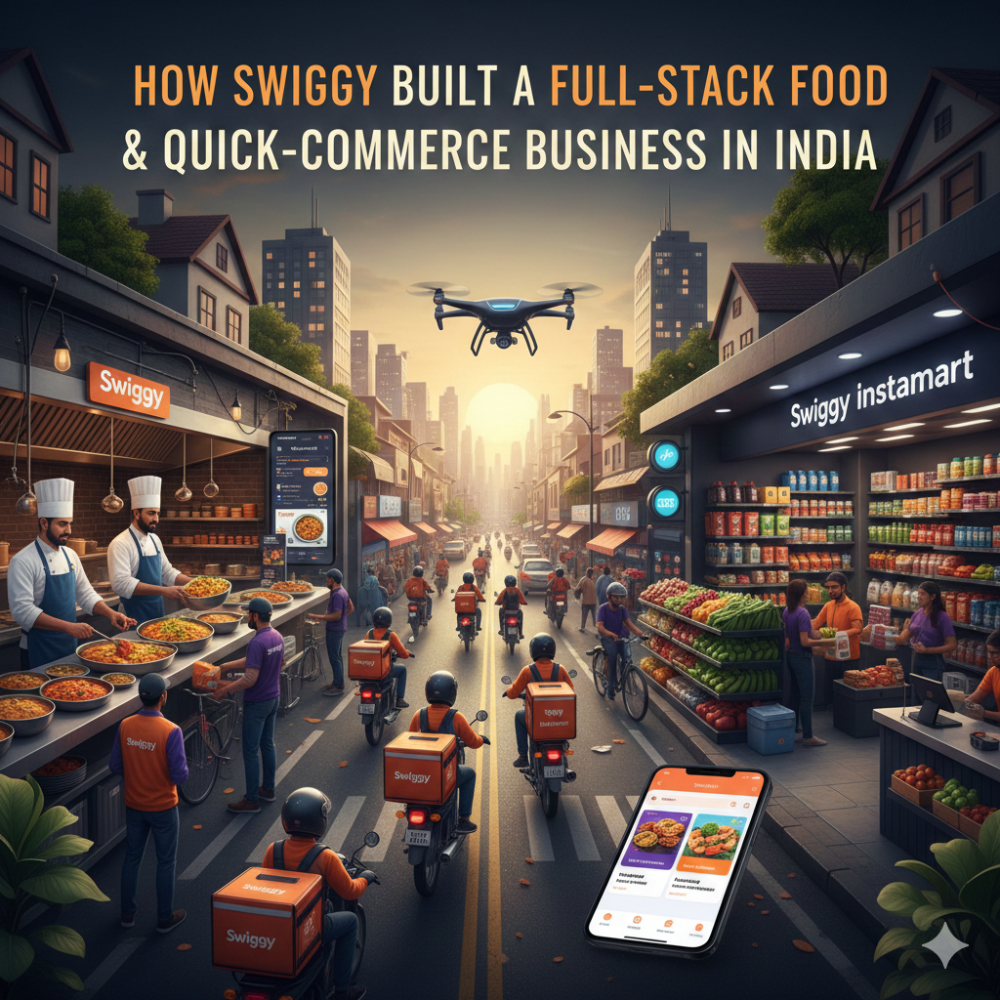
Swiggy entered the quick- commerce sector with its launch of Instamart, which provides grocery and essential goods deliveries within a matter of minutes. Rather than building their own stores, Swiggy has implemented a dark-store model—these stores serve as smaller regional warehouses that allow for quick access to high volume products. Their micro-fulfilment model enables Swiggy to offer faster picking, packing and deliveries than a traditional retailer. Swiggy employs advanced data analysis capabilities that allow them to anticipate future demand, track real-time inventory levels and identify how to manage their inventory efficiently to minimise waste. Swiggy has also integrated Instamart into Swiggy’s existing delivery networks to capture operational synergies and reduce variable costs associated with the launch of Instamart. The success of Instamart has been largely driven by the changing landscape of consumer behaviour and value, where speed and convenience often outweigh price. Overall, Swiggy’s transformation from a food-tech firm to the broader quick-commerce business, places the company in a strong position to compete against Zepto and Blinkit while continuing to gain a larger share of India’s overall on-demand economy.
Tech, Data & Customer Obsession: The Engine Behind Swiggy’s Growth
“Technology and data are the twin pillars of Swiggy’s strategy. Using artificial intelligence and machine learning solutions, Swiggy personalizes restaurant suggestions, estimates the time of food delivery, and dynamically prices food orders to ensure that suppliers optimize during peak hours. User behavior studies inform improvements to the app’s user interface and the overall ordering experience. Initiatives such as live order tracking, live chat, and quick refunds build customer loyalty and trust. Similarly, the Swiggy One program helps retain consumers through the provision of free delivery and other benefits. On the business end, data-driven solutions create efficiency through the improvement of the suppliers’ experience and restaurant efficiency. Through an unrelenting focus on the consumer and the provision of innovations through technology solutions, Swiggy has managed to retain the leading spot within an intensely competitive market segment.