
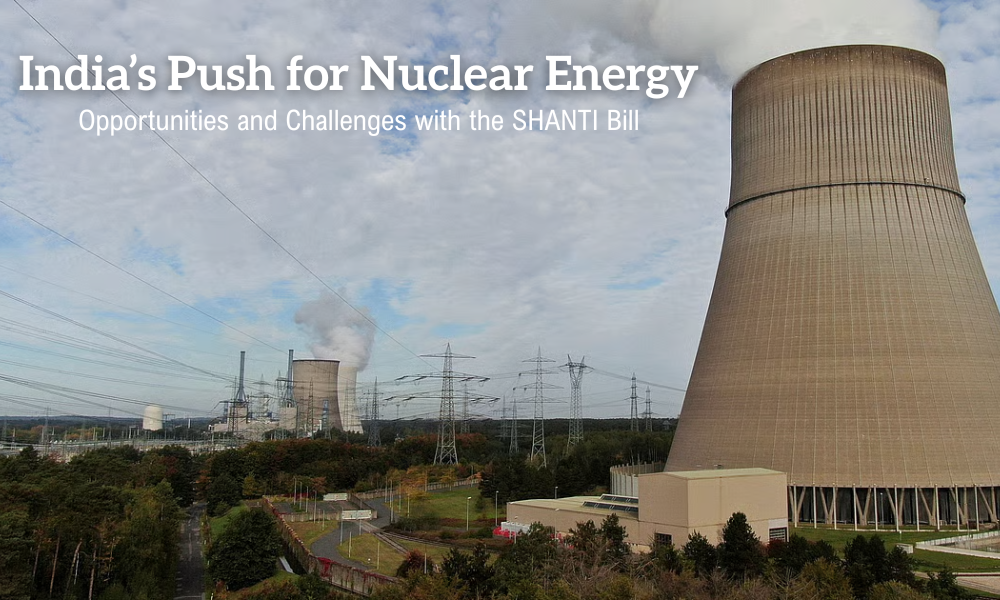
India stands at a critical juncture in its energy journey. With rapidly growing electricity demand, ambitious climate commitments, and the need for long-term energy security, the country is exploring all viable clean energy options. Alongside renewable sources like solar and wind, nuclear energy has re-emerged as a strategic pillar in India’s power mix. In this context, the proposed SHANTI Bill has drawn national attention, promising reforms aimed at strengthening nuclear safety, accelerating capacity expansion, and improving public confidence. However, like any major policy initiative, it brings both opportunities and challenges.
India’s Nuclear Energy Landscape
India’s nuclear program has a long history, dating back to the vision of Dr. Homi Bhabha. Today, nuclear power contributes a modest but stable share to the country’s electricity generation. Nuclear plants operate at high capacity factors, provide reliable baseload power, and emit minimal greenhouse gases, making them an attractive complement to intermittent renewables.
As India targets net-zero emissions in the long term, nuclear energy offers a pathway to meet rising demand without proportionally increasing carbon emissions. The government’s renewed focus reflects a recognition that energy security, climate goals, and industrial growth must progress together.
What Is the SHANTI Bill?
The SHANTI Bill—short for Safety, Harmonisation, Accountability, Nuclear Technology Integration Bill—is envisioned as a comprehensive legislative framework to modernize India’s nuclear energy ecosystem. Its core intent is to strengthen safety governance, streamline regulatory processes, promote advanced nuclear technologies, and create an environment conducive to both public and private participation.
While nuclear energy in India has traditionally been dominated by public sector entities, the SHANTI Bill signals a shift toward controlled expansion, improved transparency, and international best practices.
Key Opportunities Presented by the SHANTI Bill
- Strengthening Energy Security
One of the biggest opportunities lies in reducing dependence on fossil fuel imports. Nuclear power plants can operate continuously for long periods, ensuring stable electricity supply even when renewable output fluctuates. By enabling faster deployment of nuclear capacity, the SHANTI Bill supports India’s long-term energy independence.
- Supporting Climate and Sustainability Goals
Nuclear energy is a low-carbon source that aligns well with India’s climate commitments. The SHANTI Bill could accelerate the transition to cleaner energy by enabling the adoption of advanced reactor designs with improved efficiency and lower waste output. This supports India’s pledge to reduce emissions intensity while sustaining economic growth.
- Boosting Technological Innovation
The Bill emphasizes the integration of new nuclear technologies, including small modular reactors (SMRs) and next-generation safety systems. These technologies promise enhanced safety, lower upfront costs, and flexible deployment, particularly in regions with limited grid infrastructure. Encouraging innovation can also position India as a global leader in nuclear technology development.
- Enhancing Safety and Public Confidence
Public perception has always been a sensitive issue for nuclear energy. The SHANTI Bill places strong emphasis on safety protocols, independent oversight, and transparent reporting mechanisms. By strengthening regulatory frameworks and emergency preparedness, the Bill aims to build trust among communities living near nuclear facilities.
- Economic Growth and Job Creation
Expansion of nuclear infrastructure can stimulate economic activity across multiple sectors, including engineering, construction, manufacturing, and research. The SHANTI Bill’s focus on structured growth can create high-skilled employment opportunities and boost domestic manufacturing under initiatives like “Make in India.”
Challenges and Concerns Surrounding the SHANTI Bill
- Safety and Risk Perception
Despite advancements in technology, nuclear accidents—however rare—have long-lasting consequences. Public concern over radiation risks, waste management, and disaster preparedness remains high. Even with stronger safety provisions, convincing communities and civil society groups of the long-term safety of nuclear energy will be a significant challenge.
- Nuclear Waste Management
Managing radioactive waste is one of the most complex issues in nuclear energy. Long-term storage, transportation, and disposal require robust infrastructure and continuous monitoring. Critics argue that the SHANTI Bill must clearly address waste management strategies to avoid passing environmental risks to future generations.
- High Capital Costs
Nuclear power plants involve substantial initial investment and long construction timelines. While operational costs are relatively low, financing large-scale nuclear projects can strain public resources. Ensuring cost efficiency and preventing delays will be critical to making nuclear expansion economically viable.
- Regulatory and Institutional Capacity
Effective implementation of the SHANTI Bill depends on strong institutions and skilled regulators. Expanding nuclear capacity without adequately strengthening regulatory bodies could compromise oversight. Training, capacity building, and institutional independence are essential to ensure that safety and accountability remain uncompromised.
- Balancing Public and Private Participation
Opening the nuclear sector to greater private participation can bring efficiency and innovation, but it also raises questions about accountability and profit motives. The SHANTI Bill must strike a careful balance between encouraging investment and maintaining strict safety and ethical standards.
Public Engagement and Transparency
One of the most important aspects of the SHANTI Bill is its emphasis on transparency and stakeholder engagement. Open communication, public consultations, and access to information can help bridge the trust gap between policymakers and citizens. Without public acceptance, even the most technically sound policy risks facing resistance on the ground.
The Road Ahead
India’s push for nuclear energy reflects pragmatic energy planning in a complex global environment. Renewables alone may not meet the country’s growing demand for reliable, round-the-clock power. Nuclear energy, supported by a modern legislative framework like the SHANTI Bill, can play a vital role in ensuring stability, sustainability, and security.
However, success will depend not just on policy intent but on execution. Addressing safety concerns, managing waste responsibly, ensuring financial prudence, and maintaining public trust will be crucial. The SHANTI Bill presents an opportunity to redefine India’s nuclear future—but it also demands careful, transparent, and accountable implementation.
Conclusion
The SHANTI Bill represents a significant step in India’s evolving energy strategy. By focusing on safety, innovation, and structured growth, it opens new opportunities for nuclear energy to contribute meaningfully to the nation’s development and climate goals. At the same time, it highlights the challenges that must be addressed to ensure responsible expansion. As India navigates this path, a balanced approach—rooted in science, public engagement, and long-term thinking—will determine whether nuclear energy truly becomes a pillar of sustainable progress.