
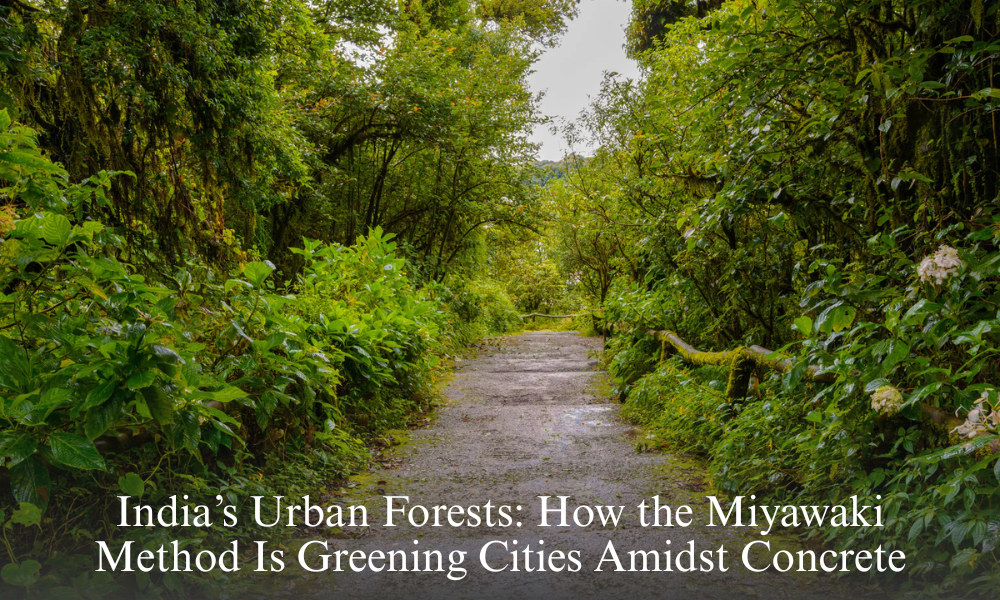
India’s Urban Forests: How the Miyawaki Method Is Greening Cities Amidst Concrete
India’s cities are expanding at an unprecedented pace. Skyscrapers, highways, and housing complexes continue to replace open land, often at the cost of green spaces. As urban heat, air pollution, and biodiversity loss intensify, the need for innovative and space-efficient ecological solutions has become urgent. One such solution gaining nationwide attention is the Miyawaki Method, a revolutionary approach to urban afforestation that is transforming small patches of unused land into dense, self-sustaining urban forests. Across India, this method is emerging as a powerful tool to bring nature back into concrete-dominated landscapes.
The Growing Need for Urban Forests in India
Rapid urbanization has drastically reduced tree cover in many Indian cities. Traditional parks and gardens, while beneficial, often require large areas, extensive maintenance, and long gestation periods before delivering environmental benefits. Meanwhile, cities face increasing challenges such as rising temperatures, worsening air quality, water runoff issues, and declining urban biodiversity.
Urban forests offer a nature-based solution to these challenges. They act as green lungs, improve microclimates, reduce noise pollution, and provide habitats for birds and insects. However, land scarcity in cities has made it difficult to establish large green spaces. This is where the Miyawaki Method has proven to be a game changer.
Understanding the Miyawaki Method
The Miyawaki Method is a forest regeneration technique developed by Japanese botanist Dr. Akira Miyawaki. Unlike conventional tree plantation methods, this approach focuses on creating dense, multi-layered forests using native plant species. The key principle is to mimic the natural structure of indigenous forests, allowing them to grow faster and become self-sustaining.
Trees planted using the Miyawaki Method grow up to ten times faster and become fully functional forests within 20 to 30 years, compared to the 100 years typically required for natural forest growth. This rapid growth is achieved through dense planting, soil enrichment, and careful selection of native species.
Why the Miyawaki Method Works in Urban Areas
One of the biggest advantages of the Miyawaki Method is its ability to thrive in small spaces. Urban forests can be created on plots as small as a few hundred square meters, making it ideal for city environments. Vacant plots, school grounds, office campuses, road medians, and even industrial areas can be transformed into green ecosystems.
The dense planting ensures that trees grow straight and tall as they compete for sunlight. This not only accelerates growth but also creates thick foliage that absorbs pollutants, reduces heat, and enhances biodiversity in a short span of time.
Implementation of Miyawaki Forests Across Indian Cities
Several Indian cities have embraced the Miyawaki Method as part of their environmental and sustainability initiatives. Municipal corporations, corporate organizations, educational institutions, and community groups are actively supporting urban forest projects.
Cities like Bengaluru, Pune, Chennai, Hyderabad, Mumbai, and Delhi have witnessed the creation of multiple Miyawaki forests in recent years. These forests are often established near residential areas, industrial zones, and public spaces, offering environmental benefits to surrounding communities.
Many state governments and urban local bodies are also integrating Miyawaki plantations into smart city projects and urban development plans, recognizing their role in improving quality of life.
Environmental Benefits of Miyawaki Urban Forests
The impact of Miyawaki forests extends far beyond aesthetics. These dense green patches significantly improve air quality by absorbing carbon dioxide and filtering particulate matter. They help reduce the urban heat island effect by lowering ambient temperatures and providing shade.
Miyawaki forests also enhance groundwater recharge by improving soil permeability. Their multi-layered structure supports diverse plant and animal life, encouraging the return of birds, butterflies, bees, and small mammals to urban environments.
Additionally, these forests act as natural sound barriers, reducing noise pollution in busy city areas.
Social and Community Impact
Beyond environmental benefits, Miyawaki forests have a strong social dimension. Many projects involve local communities in plantation and maintenance activities, fostering environmental awareness and a sense of ownership. Schools and colleges use these forests as outdoor classrooms to teach students about ecology, biodiversity, and climate change.
Urban forests also provide mental health benefits. Green spaces are known to reduce stress, improve mood, and promote physical activity. Even small patches of dense greenery can create a calming effect amid urban chaos.
Maintenance and Sustainability
While the Miyawaki Method requires intensive care during the initial two to three years, including watering and weeding, the forest becomes self-sustaining after this period. Native species adapt naturally to local climate and soil conditions, reducing long-term maintenance needs.
This low-maintenance nature makes Miyawaki forests a cost-effective solution for cities with limited resources. Once established, they require minimal human intervention, making them sustainable in the long run.
Challenges in Adopting the Miyawaki Method
Despite its advantages, the Miyawaki Method is not without challenges. Proper planning, scientific soil preparation, and correct species selection are crucial for success. Poor execution can lead to plant mortality and reduced forest health.
Another challenge is public perception. Some people expect immediate visual results and may not appreciate the initial dense and wild appearance of Miyawaki forests. Continuous awareness and education are needed to help citizens understand the long-term value of these ecosystems.
The Role of Policy and Corporate Participation
Government support and corporate participation play a vital role in scaling up Miyawaki forests across India. Corporate social responsibility initiatives, urban sustainability programs, and climate action plans can provide funding and technical expertise for such projects.
Clear guidelines, expert involvement, and long-term monitoring can ensure that urban forest initiatives deliver meaningful and lasting benefits.
The Future of Urban Greening in India
As Indian cities continue to grow, the importance of innovative greening solutions will only increase. The Miyawaki Method offers a practical, scalable, and scientifically proven approach to restoring nature in urban settings. By transforming unused land into thriving forests, cities can combat pollution, improve climate resilience, and enhance overall livability.
Conclusion
India’s urban forests, created through the Miyawaki Method, represent a hopeful shift in the way cities approach environmental restoration. Amidst concrete jungles and expanding infrastructure, these dense green spaces serve as reminders that nature can coexist with urban development. With proper planning, community involvement, and policy support, the Miyawaki Method has the potential to redefine urban landscapes and create healthier, greener cities for future generations.