
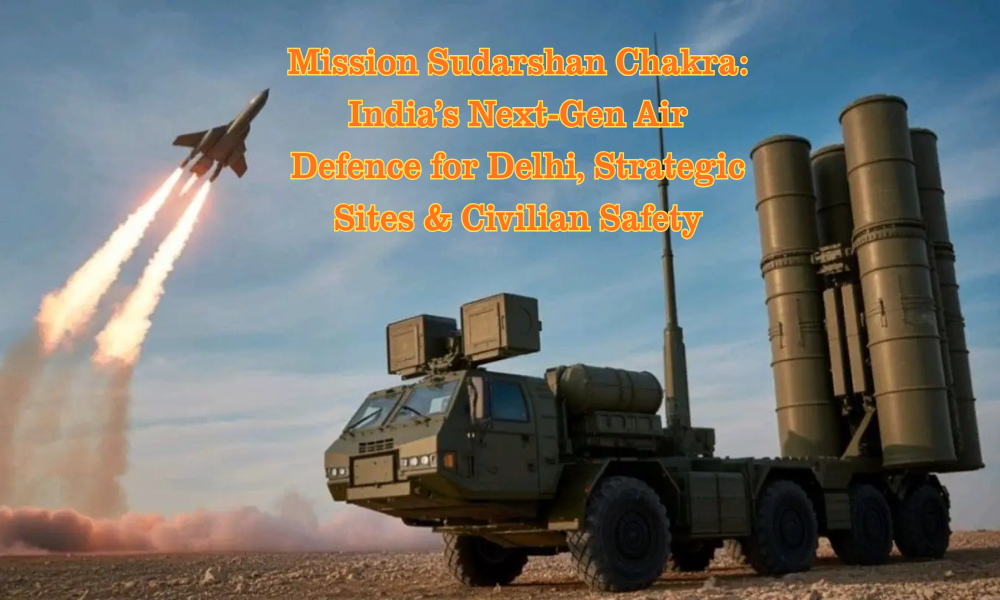
In a significant stride toward strengthening India’s national security architecture, Prime Minister Narendra Modi announced the launch of Mission Sudarshan Chakra an ambitious indigenous initiative to develop a multi-layered air and missile defence system capable of safeguarding strategic, military, civilian, and critical infrastructure across the nation. This vision, articulated during India’s 79th Independence Day address, marks a major pivot in defence strategy toward self-reliance (Aatmanirbhar Bharat) and advanced technology integration in air defence.
What Is Mission Sudarshan Chakra?
At its core, Mission Sudarshan Chakra is designed as a national protective umbrella a comprehensive, multi-layered air and missile defence shield that will detect, track, intercept, and neutralize a wide array of aerial threats, from drones and fighter aircraft to cruise and ballistic missiles. Inspired by the mythological Sudarshan Chakra the celestial discus associated with speed, precision, and protection the mission aims to provide an unmatched defence layer that covers both military and civilian domains.
Unlike conventional defence systems that rely on discrete components, Sudarshan Chakra represents an integrated networked architecture combining cutting-edge sensors, artificial intelligence (AI), advanced interceptor missiles, radar systems, cyber-defense tools, and command-and-control infrastructure to create a rapid, coordinated response against sophisticated aerial threats.
Why It Matters for India’s Security
India’s evolving threat landscape includes not just traditional state adversaries but also emerging hybrid threats including swarm drones, precision-guided munitions, hypersonic platforms, and cyber-enabled attacks. As demonstrated during Operation Sindoor, India’s existing defence networks like the Integrated Air Command and Control System (IACCS) played a crucial role in countering aerial hostilities. Mission Sudarshan Chakra builds on these lessons, aiming to extend coverage to urban centres, critical civilian infrastructure (such as hospitals, railways, and places of faith), and strategic military bases.
By creating an all-encompassing protective layer, the mission seeks to ensure that every citizen feels secure, and the nation’s defence posture remains resilient against both conventional and non-conventional threats.
Key Components & Technological Foundation
- Multi-Layer Defence Architecture
Mission Sudarshan Chakra will not depend on a single weapon but instead comprise multiple layers of defence:
Short-Range Systems: Designed to counter low-altitude threats such as drones and cruise missiles using systems similar to VSHORADS and quick reaction surface-to-air missiles (QRSAM).
Medium & Long-Range Interceptors: These will engage hostile aircraft and long-range missiles, leveraging next-generation interceptor missiles developed under Project Kusha India’s indigenous missile-defence backbone with M1, M2, and M3 variants (ranging from ~150 km to 350–400 km capabilities).
Directed Energy Weapons (DEWs): High-power laser systems that can neutralize threats at the speed of light, part of India’s leap into futuristic battlefield technologies.
- Integration with Existing Defence Networks
Sudarshan Chakra is not a standalone tool but a networked umbrella that will integrate seamlessly with existing defence assets:
The Integrated Air Command and Control System (IACCS) — linking radars, satellites, fighter aircraft, and missile systems into a unified defence grid.
Existing interceptor systems such as the S-400 “Sudarshan Chakra” air defence batteries — India’s long-range Russian-made missile system with engagement ranges up to ~400 km, currently integrated into India’s defence network.
National assets like the Akash Prime and Barak-8 missile systems, creating redundancy and layered engagement options at various altitudes and ranges.
his multi-domain integration will allow defence planners to coordinate across air, land, sea, space, and cyber domains ensuring swift detection, attribution, and engagement of aerial threats.
Strategic Goals and Timeline
The vision for Mission Sudarshan Chakra extends through multiple phases, with full deployment targeted by 2035. The roadmap includes:
2026: Commencement of trials for the indigenous M1 interceptor missile marking the first major test under the Project Kusha framework.
2028–2030: Progressive trials and integration of advanced interceptor variants (M2 and M3), AI-enabled defence decision systems, and expanded radar networks.
By 2035: Establishment of a robust, nationwide integrated defence shield covering strategic sites, urban centres (including Delhi and the National Capital Region), and high-value civilian infrastructure — effectively creating an airspace security “bubble” over the heart of the nation.
This phased approach reflects the complexity and scale of the project, from prototype testing to operational deployment and nationwide coverage.
Comparisons & Global Context
Mission Sudarshan Chakra is often assessed alongside global air-defence initiatives, such as:
Israel’s Iron Dome: A short-range coastal defence network known for its high success rate against rocket barrages.
United States’ Golden Dome: Proposed large-scale multi-layer defence shield concepts.
However, Sudarshan Chakra’s scope is broader — aiming to protect a geographically vast and densely populated nation like India, with tailored solutions to counter both traditional military platforms and emerging technologies such as swarm drones or hypersonic weapons.
Challenges & Future Prospects
While the strategic logic behind the mission is compelling, its execution presents several challenges:
Integration Complexity: Merging disparate sensors, weapons, and command systems into a unified AI-enabled architecture demands extensive testing and refinement.
Budgetary and Technical Hurdles: Delivering cutting-edge interceptor systems and directed energy weapons — while ensuring reliability across diverse threat environments — will require significant investment and sustained research.
Operational Readiness: Developing indigenous solutions that match or exceed global benchmarks — while ensuring seamless coordination between services (Air Force, Army, Navy) — adds another layer of complexity.
Nevertheless, India’s drive toward self-reliance in defence technology — rooted in DRDO’s innovations and industry collaboration — positions the Sudarshan Chakra mission as a landmark in national security strategy.
Conclusion
Mission Sudarshan Chakra is more than a defence initiative; it is a strategic statement about India’s future security posture — one that blends indigenous innovation, advanced technology, and integrative networked defence to protect its people, infrastructure, and sovereignty. With phased deployment by 2035, this initiative promises to redefine the nation’s air and missile defence ecosystem, reinforcing India’s ability to deter and defeat emerging aerial threats.