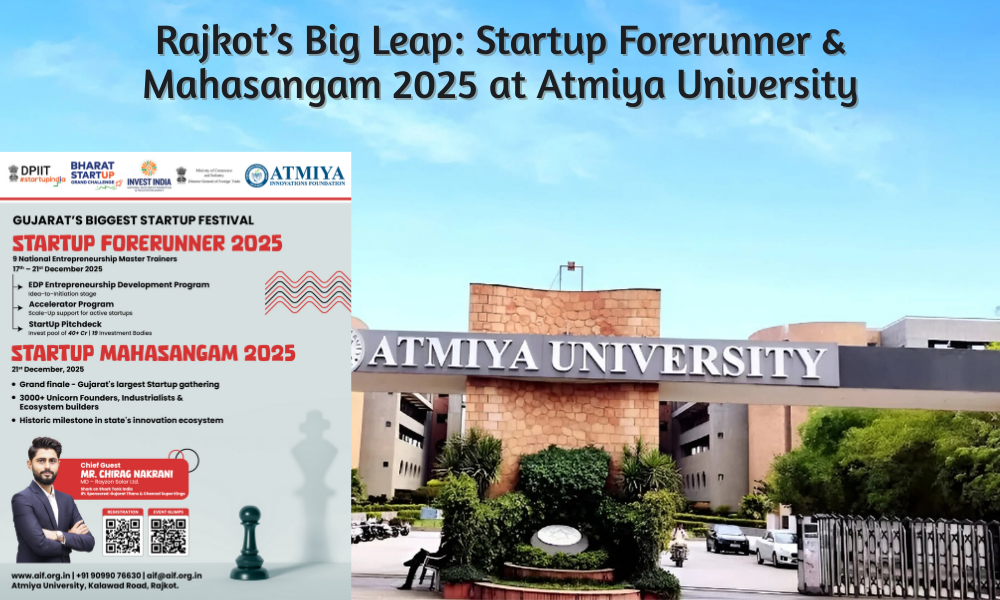
As dawn breaks over the quiet streets of Rajkot, a gentle buzz begins. Inside the sprawling grounds of Atmiya University, hundreds of young minds — students, fresh graduates, dreamers — stir not just from sleep, but from ambition. For days now they’ve been preparing: polishing ideas, rehearsing pitches, tweaking slides. The date is near. From December 17 to 21, 2025, the campus transforms. It becomes not just a university — but a furnace where dreams are tempered, connections forged, and new ventures born. This is the story of Startup Forerunner & Mahasangam 2025.
What is Startup Forerunner & Mahasangam 2025?
Atmiya University — a privately run institution in Rajkot, established in 2018 — has taken a bold step. Through its innovation wing, Atmiya Innovations Foundation (AIF), it is hosting what’s being billed as one of Gujarat’s largest startup festivals. Over five days, the campus will welcome thousands: budding entrepreneurs, seasoned startups, mentors, and investors.
The festival blends two major programs:
An Entrepreneurship Development Program (EDP) aiming to guide more than 400 aspiring entrepreneurs — helping transform their raw ideas into structured business models.
A Startup Accelerator Program, aimed at giving about 300 already-running startups the tools they need to scale — investor readiness, strategic mentoring, and growth roadmaps.
In addition: over 26 mentors, 19 venture-support partners, and 30+ industry experts from varied sectors will be present. The expectation: more than 3,000 startups/entrepreneurs participating across Gujarat.
For an institution barely a decade old, this ambition signals something bigger — a vision to position Rajkot as a key node in Gujarat’s booming startup-ecosystem.
Seeds of Entrepreneurship — Why Atmiya is the Right Ground
Atmiya University isn’t new to innovation or entrepreneurial ambition. It hosts the E Yuva Centre — a dedicated incubation and fellowship grants platform for students and researchers. Through E Yuva, university teams have already founded startups tackling diverse problems: from eco friendly packaging made from agricultural waste, to sustainable energy solutions, to natural mosquito repellents and biodegradable hygiene products.
The E Yuva Centre offers incubations, mentorship, funding support, and a strong network — turning academic corridors into launchpads. In this light, Startup Mahasangam 2025 feels like a natural evolution: a larger, community-wide amplifier, and not just a campus internal affair.
Moreover, under the state’s Student Startup & Innovation Policy (SSIP), institutions like Atmiya have a mandate and support framework to build student centric innovation ecosystems — to help convert ideas to market-ready startups.
The Atmosphere: From Classrooms to Startup Festival Halls
Picture this: the early morning classes and quiet libraries of Atmiya replaced by buzzing registration counters, big banners proclaiming “Startup Forerunner & Mahasangam 2025”, and eager faces everywhere. Large halls become demo-zones. Corridors echo not just with lectures, but with animated pitches.
Day one — rookies take part in workshops, refine their problem statements under mentors’ guidance. Day two and three — pitch rehearsals, networking sessions, validation of ideas. By day four, booths and prototype stands appear. Founders hover behind their stalls, ready to demonstrate their innovations: a green-hydrogen idea here, a biodegradable packaging product there, a health-tech mobile app in the corner. Around them roam investors, venture-support partners, industry veterans.
Late evenings — panel discussions, fireside chats, mentorship clinics. Seniors advising on funding, marketing, scaling. Newer startups asking tough questions, hungry for feedback. Everywhere: dialogue, collaboration, possibility.
And the festival crescendos to a big “Mahasangam Day” on the final day: where selected startups pitch to a panel of investors and mentors — seeking funding, incubation support, or tie-ups. For many, this could be the moment when a dream crosses the line into reality.
Beyond Festivity: What’s at Stake
To many participants, this isn’t just an event — it’s a launching pad. For students who’ve been juggling academics and side-ideas, this is a chance to see if their concept has legs. For small entrepreneurs in Rajkot and nearby towns, it’s an opportunity to break out — to meet investors, get guidance, and perhaps scale beyond local markets.
For the broader ecosystem, the festival could seed several wins: more startup-success stories from smaller cities, better innovation infrastructure, job creation, and ultimately — a more diversified, inclusive entrepreneurship culture in Gujarat beyond the big metros.
For Atmiya University, success here could establish its reputation not just as an educational institution, but as a hub of entrepreneurship — drawing more students, industry collaborations, R&D efforts, and venture partnerships.
Challenges and Hopes
However, big festivals come with big expectations — and challenges. Turning ideas into viable startups requires more than enthusiasm. Post-festival follow-up, consistent mentorship, market-validation, funding — all matter. Many startup festivals end with applause and good memories; only few convert into sustainable ventures. For participants, the real journey begins after the festival ends.
Also, inclusivity is key. For a statewide festival, ensuring that students and innovators from smaller towns, rural areas, or underprivileged backgrounds get access — both physically and financially — will determine whether this truly strengthens Gujarat’s startup ecosystem.
But there’s hope. With the backing of SSIP, institutional support from Atmiya, experienced mentors, and a growing appetite for entrepreneurship in Gujarat — the chances are real.
A Few Stories Inside the Story
Among the sea of faces will be a 22-year-old final-year engineering student from Saurashtra, nervously presenting a prototype of a low-cost water-purification filter — hoping to take it to villages where clean water remains a challenge. There will be a group of college friends from Rajkot, pitching a smartphone app aimed at connecting local artisans to national markets. A young woman — returning from a bigger city — showing her eco-friendly biodegradable hygiene-product startup. A small team working on green-energy solutions, dreaming of making sustainable energy accessible to rural India.
Each story — raw, hopeful, tentative — brings with it the possibility of change. If even a handful of these convert into real ventures, they could reshape communities, livelihoods, and the startup narrative of Gujarat.
What This Festival Represents for Gujarat & India
In a time when the national dialogue is shifting — from job-seeking youth to job-creating entrepreneurs — festivals like these are more than events. They are signals. Signals that smaller cities like Rajkot are waking up to their potential. That innovation isn’t just for big metros. That universities can — and should — be breeding grounds for startups, not just degree factories.
If Startup Forerunner & Mahasangam 2025 succeeds, it could become a model — for other universities in Gujarat, and across India — showing how education, mentorship, policy support, and youthful energy can come together to ignite an innovation revolution beyond traditional tech hubs.
In Conclusion — A New Dawn for Rajkot’s Entrepreneurs
When December 21 ends, and festival banners come down, at Atmiya University there will be more than empty chairs and closed booths. There will be ideas — sharpened, validated, connected. There will be new business cards exchanged, new teams formed, new dreams taking shape.
For many, Startup Forerunner & Mahasangam 2025 will be the beginning — not the end. For Gujarat, it might mark a turning point. Because real progress doesn’t arrive with a single festival — but with every startup that refuses to fade after the applause.
If you listen carefully, you can already hear it: the hum of engines starting. Rajkot is ready.