
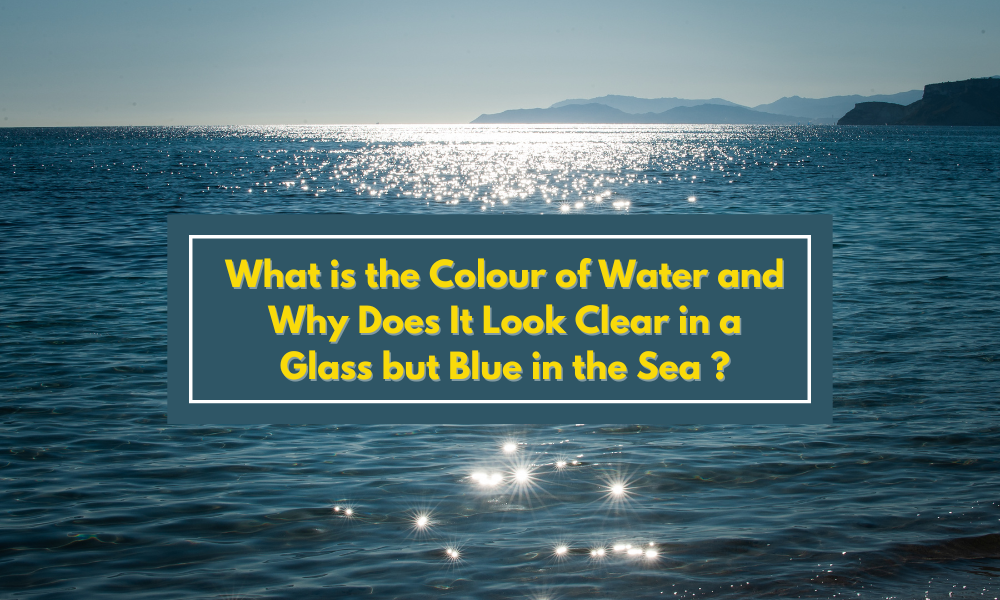
Water is one of the most familiar substances on Earth, yet it still surprises us. We drink it, bathe in it, and see it every day but have you ever stopped to ask: what is the colour of water? If water fills a glass, it looks perfectly clear. But when we stand by the ocean, lakes, or deep rivers, the water often appears a rich blue. This contrast leads to a fascinating scientific question: why does water look colourless in small amounts but blue in large bodies like the sea?
The answer lies in the way water interacts with light, depth, and its surroundings.
Is Water Actually Colourless?
Water is commonly described as colourless and transparent, but this is only partly true. Pure water does have a colour it is very slightly blue. However, this blue colour is so faint that it becomes noticeable only when light passes through a large volume of water.
In a small quantity, such as a glass of water, the path of light is too short for the blue colour to be detected by our eyes. As a result, water appears clear or colourless.
Understanding Light and Colour
To understand why water looks blue in the sea, we need to know how light behaves.
Sunlight appears white, but it is actually made up of many colours, including:
Red
Orange
Yellow
Green
Blue
Violet
These colours have different wavelengths. When light enters a material, some wavelengths are absorbed while others are scattered or reflected.
How Water Interacts with Light
When sunlight enters water:
Water absorbs longer wavelengths such as red, orange, and yellow.
Shorter wavelengths, especially blue, are absorbed less and scattered more.
As light travels deeper into the water, more red light is absorbed, leaving mainly blue light to be scattered back to our eyes. This is why large bodies of water appear blue.
The deeper the water, the stronger this effect becomes.
Why Water Looks Clear in a Glass In a glass of water:
- The light passes through only a few centimetres of water.
- There is not enough distance for water to absorb significant amounts of red light.
- Almost all colours pass through equally.
- Because no single colour dominates, the water appears transparent or clear.
- Why the Sea Appears Blue
- The sea looks blue mainly because:
- Depth of water allows selective absorption of red wavelengths.
- Scattering of blue light sends blue wavelengths back toward our eyes.
This natural filtering effect makes oceans and deep lakes appear blue even when the water is very clean.
It’s important to note that the sea is not simply reflecting the colour of the sky. While sky reflection can slightly influence surface colour, it is not the primary reason oceans appear blue.
The Role of the Sky’s Reflection
A common myth is that the ocean is blue because it reflects the blue sky. While reflection does play a small role, it is not the main cause.
If sky reflection were the only reason:
The sea would look grey on cloudy days.
The ocean would change colour dramatically with sky conditions.
In reality, the sea often remains blue even under overcast skies, proving that light absorption and scattering within water are the dominant factors.
Why Some Seas and Lakes Look Green or Brown
Not all water bodies look blue. Their colour can change due to:
Algae and phytoplankton, which absorb blue light and reflect green
Suspended particles like sand, mud, or silt
Organic matter such as decaying plants
For example:
Coastal waters often look green due to plankton.
Rivers may appear brown because of sediment.
Glacial lakes can look turquoise due to fine rock particles scattering light.
Thus, the colour of water is influenced not only by light absorption but also by what is dissolved or suspended in it.
Does Water Ever Look Blue in Small Quantities?
Under certain conditions, water can show its blue colour even in smaller volumes:
Very pure water in large glass containers
Icebergs or thick ice blocks
Swimming pools with clean water and light-coloured surfaces
These situations allow light to travel through enough water to reveal its subtle blue tint.
Scientific Proof That Water Is Blue
Scientists have measured the absorption spectrum of water and confirmed that it absorbs red light more strongly than blue. This has been demonstrated in laboratory experiments using long tubes filled with ultra-pure water.
This scientific evidence proves that water has an intrinsic blue colour, even though it is nearly invisible in everyday situations.
Why Human Eyes Perceive Water as Clear
Our eyes are more sensitive to stronger colours. Since water’s blue colour is extremely weak:
The human eye cannot detect it in thin layers.
Other visual cues, like reflections and background colours, dominate.
This is why water in a glass looks colourless, even though it technically has a colour.
Why This Knowledge Matters
Understanding the colour of water is more than just curiosity:
It helps scientists study ocean health
It aids in satellite monitoring of water bodies
It supports research in climate science and marine biology
Changes in water colour can indicate pollution, algal blooms, or environmental shifts.
Conclusion
So, what is the colour of water? Water is naturally blue but only very faintly. In small amounts, such as a glass, it appears clear because the blue colour is too weak to see. In large bodies like oceans and deep lakes, water absorbs red light and scatters blue light, giving it its characteristic blue appearance.
This beautiful phenomenon reminds us that even the most familiar things can hold surprising scientific secrets waiting to be understood.